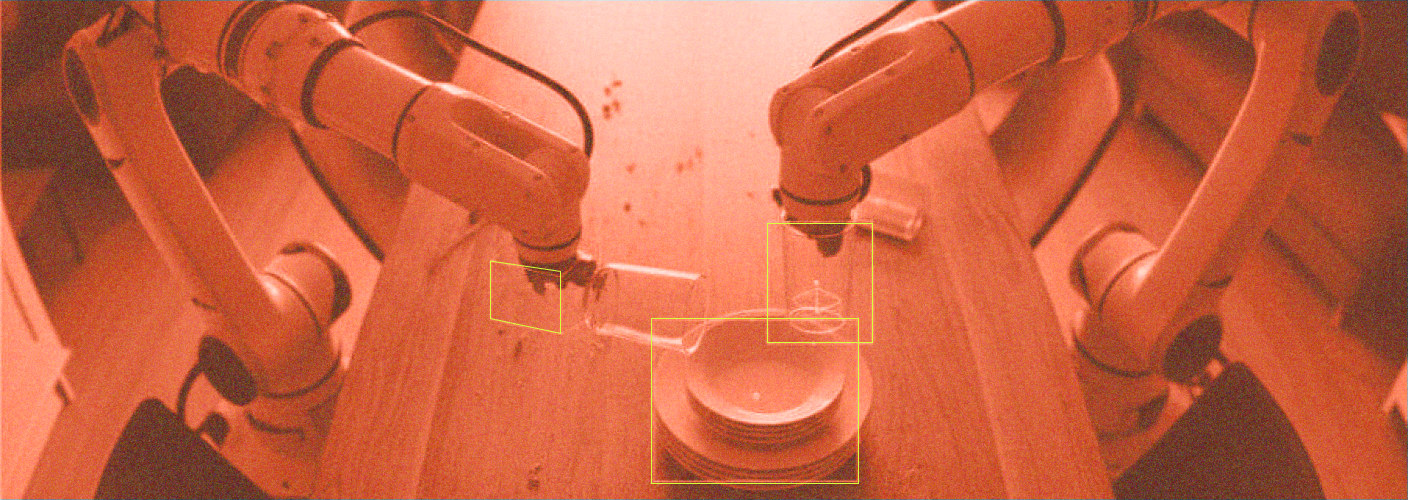
TL;DR Summary: VLA training data plays a crucial part in teaching AI models by bridging the gap between digital intelligence and physical execution. This is where a complete pipeline - from collection through validation, QC, annotation, and human-in-the-loop review - matters more than raw data volume, and it's the foundation Humyn Labs' physical AI data services are built on.
VLA models introduction: The data bottleneck
A Vision-Language-Action model is designed to give humanoids a complete understanding of the surroundings, building on the same foundation as vision-language models (VLMs). Unlike traditional robotics, an open VLA model operates as a single unified system. By processing visual input from static images and high-level language instructions, VLA models map them to real-time commands.
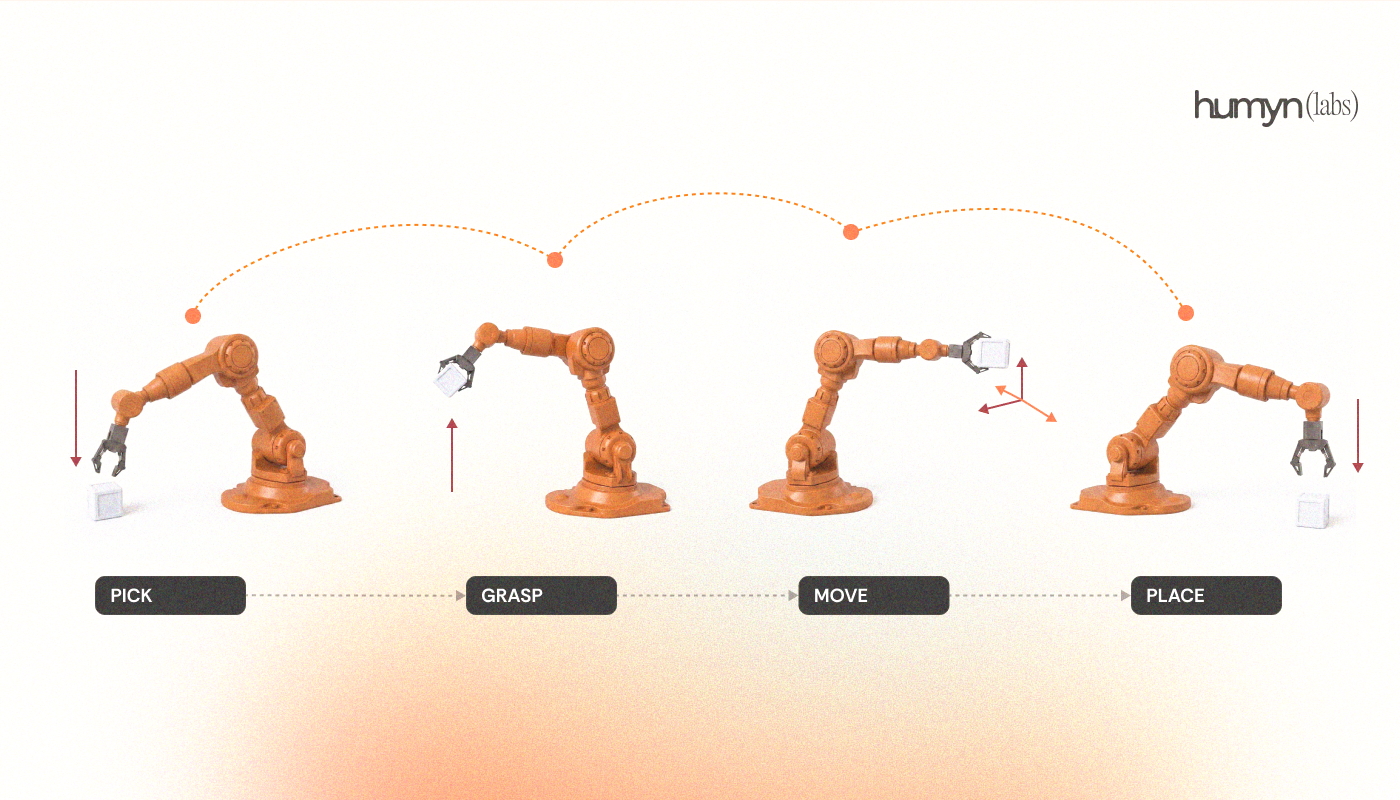
However, the primary obstacle to advancing this system is the physical data bottleneck. VLA models require embodied trajectory data, making them more complex than conventional AI databases.
Besides that, VLA models need variation to help AIs handle different environments, tasks, and scenarios. The main challenge is that collecting real-world data is expensive, time-consuming, and difficult to scale.
VLA dataset core modalities
A dataset must capture more than visual footage to train a VLA model by combining intent, perception, and motor output into a single aligned package. VLA dataset records rely on four core modalities:
Perception: Visual data gives information about the robot's surroundings, including images, videos, and depth maps from different cameras. Most training datasets use two views: workspace view and wrist view.
Language & goal prompts: This core VLA dataset modality connects a human's intention with a physical task. Besides that, this modality tells AI models what tasks they need to perform, such as generating goal images or following high-level instructions.
Proprioception: Proprioception can act like an AI model's internal awareness. It will sense its own physical posture, movements, and interactions with the surroundings. Proprioception will help robots do these tasks without relying on external cameras.
Action trajectories: The final data modality is action trajectories, the target labels that VLA models learn to predict. Modern VLA datasets record movements as action chunks instead of sending individual points.
Where does VLA training data come from?
VLA training data can come from different sources. However, engineers rely on four primary sourcing methods: real-world teleoperation, cross-embodiment datasets, human egocentric video retargeting, and synthetic simulation.
1. Real-world teleoperation
Real-world teleoperation is a unique method involving a human operator controlling a physical robot. The AI model's movements are recorded as it performs a task. Human operators use exoskeleton arms and VR controllers to guide the robot in real time. Teleoperation provides the highest quality data, but it is slow and difficult to scale.
2. Cross-embodiment datasets
Most teams use cross-embodiment open datasets that have a pool of trajectory data across different AI models, tasks, and scenarios. Instead of starting from scratch, engineers prefer cross-embodiment datasets for immediate scale. However, these open datasets require normalization and extensive cleaning before training.
3. Human egocentric video retargeting
Researchers extract physical insights from videos of humans performing tasks while using cameras. Advanced computer algorithms track human motions and translate them into coordinates an AI robot arm can understand. Egocentric video retargeting is available at an affordable price.
4. Synthetic simulation
When physical hardware collection faces limitations, synthetic data engines play a crucial role in generating millions of virtual practices. The best part of synthetic simulation is it has zero risks and infinite scale. However, physics engines often struggle to replicate real-world scenarios.
VLA data pipeline engineering
Collecting trajectory data is only the first step of VLA model training. The trajectory data must move through the designed pipeline that removes unnecessary samples, adds useful annotations, and prepares complete model training trajectories - this is exactly where Humyn Labs' end-to-end physical AI data pipeline comes in, covering collection, validation, multilayer quality checks, annotation, and human-in-the-loop review. Designing a VLA data pipeline involves solving three technical challenges:
Cross-embodiment action space challenge: The pipeline has to map its unique mechanical design into a unified action space while training a VLA model. As raw motor angles rarely translate from one AI model to another, pipelines convert movements into relative position changes.
Action chunking: The pipeline uses precise interpolation algorithms or hardware timestamps to match video frames. VLA models don't predict single motor adjustments. Otherwise, it will end up with uncoordinated and jerky motors. That's why data pipeline formats target labels into action chunks.
File format & storage architecture: Multimodal robotics files can be heavy. Storing these files requires specialized dataset formats. Engineers rely on specialized storage architecture for massive multi-robot datasets.
VLA training data curation, labelling & annotation
Collecting raw data is the first step of training. If the dataset has dropped objects, wrong instructions, or long pauses, the VLA model will develop bad habits. Engineers curate VLA data by cleaning up erroneous movements, adding clear text labels, and verifying that the robot practices in different environments.
Cleaning up raw records: Humans make mistakes during manual testing. Pipelines clean up these raw records, trimming out long pauses, filtering out failures or unnecessary clips. Besides that, the pipeline will smooth the shaky moves.
Adding clear text labels: When a video record needs matching text instructions, a pipeline adds three levels of text labels, like main goals, breaking the video into small stages, and using AI to generate different commands for the instruction.
Avoiding bias: The training will fail when every video shows an object placed in the exact same location. Engineers will track and map the starting position to get filtered VLA training data.
How VLA models learn from training data
Once raw data is collected, normalized, and labelled, engineers will feed it into the VLA network. A VLA robot will learn to execute physical actions from training data through a two-step strategy:
Step 1: Co-training & pre-training foundation
Before VLA training data can control a robot arm, it needs to understand the surroundings. Instead of training exclusively with raw trajectories, modern VLA models use the co-training technique. This method mixes internet-scale data with physical robotics data for pre-training.
This stage also focuses on preserving semantic reasoning and visuals by training on web images. Besides that, cross-modal alignment maps visual and text tokens into a shaped mathematical space to set up the pre-training foundation.
Step 2: Fine-tuning & action prediction
The AI model learns to convert the visuals and semantic understanding into motor control. In the fine-tuning stage, the robot maps inputs to actions using tokenized prediction and diffusion-based prediction.
Simulation data vs real-world VLA data
Engineers face a classic challenge while building a VLA training dataset: the simulation data vs real-world data question. A company must decide how much data to collect from physical hardware and generate inside the simulator.
Simulation data vs real-world VLA data: head-to-head comparison
| Real-world data | Simulation data | |
|---|---|---|
| Collection speed | Slow real-time human speeds | Instant parallel GPU cluster |
| Hardware safety | High risk of damage | Zero risk |
| Data cost | High, including operators and hardware | Low, including software and compute |
| Annotation effort | Semi-automated or manual | Fully automated |
Real-world data comes from physical robots moving through different rooms, kitchens, and factories. AI models trained on real-world data have minimal errors. However, real-world data collection is a slow, labour-intensive, and expensive process.
On the other hand, simulation data is generated inside a virtual environment where AI models interact with 3D objects. Virtual environments can run thousands of scenarios 24/7. Besides that, simulation data has zero hardware risk. The only drawback is that simulation data often fails to replicate real-world physics.
Challenges of building VLA training datasets
Engineers often face some challenges while building VLA training datasets. They can be structural, financial, and physical obstacles like:
Cost bottleneck: Collecting real-world data requires physical hardware, human oversight, and a dedicated space. Companies also have to face high capital costs to maintain VLA training datasets compared to cloud server storage.
Generalization & broad real-world physics: Unlike language models, VLA models often deal with uncertain physical environments. Teaching an AI model to handle rigid objects is simple. However, teaching these models to handle deformable objects might be challenging.
Failure & safety: Physical mistakes can create real-world damage. As most datasets record successful demonstrations only, AI models rarely learn what to do or what not to do.
Conclusion: VLA training data is essential to teach AI models with human instructions and physical actions. Unlike traditional datasets, VLA datasets require multi-modal information, including language prompts, visual data, and action trajectories. VLA pipeline normalizes action spaces, handles multiple files, and organizes action chunks. Proper curation, annotation, and labelling are essential for removing errors. Even though real-world data offers accuracy, simulation data provides greater scale at a lower cost. Building VLA datasets can also be challenging due to high costs, physical safety risks, and data failure.
Humanoids are getting better at understanding their surroundings. However, the real challenge arrives when you try to teach them how to act on that understanding. Here come VLA models, aka Vision-Language-Action models. VLAs allow robots to understand actions by connecting visual information, physical actions, and natural-language instructions.
Building a VLA model requires more than static image or video collections. The VLA training data needs to cover different environments, tasks, and real-world scenarios. Besides that, training datasets have to connect what the robot sees with the received instructions.
Key Takeaways:
1. VLA training data combines language instructions, visual information, and action trajectories into a single aligned package
2. Real-world teleoperation, cross-embodiment datasets, egocentric video retargeting, and synthetic simulation are the four primary data sources
3. The VLA data pipeline solves three core challenges: action space normalization, action chunking, and file format architecture
4. Proper curation, labelling, and annotation are essential for removing errors and avoiding bias
5. Real-world data offers accuracy; simulation data offers scale — most engineers combine both
6. Cost, physical safety risks, and generalization across real-world physics are the main challenges in building VLA datasets
FAQs
Q: What is VLA training data?
Vision-Language-Action training data is multimodal data used to train AI models. VLA data combines language instructions, visual information, and raw action trajectories.
Q: Can simulation data be used to train VLA models?
Yes, simulation can generate a large amount of data without risking damage to physical hardware. However, a simulation world can't replicate real-world physics.
Q: Is real-world training data better than simulation data?
Real-world data offers accuracy, while simulation provides greater scale at a lower collection cost. Engineers often combine both real-world and simulation VLA training data for more balanced datasets.
Q: How much VLA training data does an AI model need?
The required volume of VLA training data depends on the AI model, tasks, environments, and other factors. Besides dataset size, diversity and data quality are also crucial.
More Articles
 ASR model comparison
Divyajot SinghSep 28, 20266 min read
ASR Models Have Different Failure Geometries
WER alone hides how ASR models fail. BRIDGE ASR 2.0 compares Gemini, GPT-4o, Saaras & Scribe on Indic, code-switched speech by error type.
Read Article→ body camera footage for ai
Pushpak AgrawalSep 10, 20264 min read
Body Camera Footage vs Scaled Crowdsourced Video: Sourcing Egocentric Data at Scale
Body camera footage caps first-person AI training data at whatever hardware a program can issue. See why scaled, verified crowdsourcing gets egocentric data further.
Read Article→ WER
WERDebashish GhoshSep 3, 20263 min read
A transcript that was perfect — yet scored 15% wrong
A perfect transcript can still fail a WER test when code-switched words have two valid spellings. Here's how a normalization pipeline removes the scoring artifact.
Read Article→