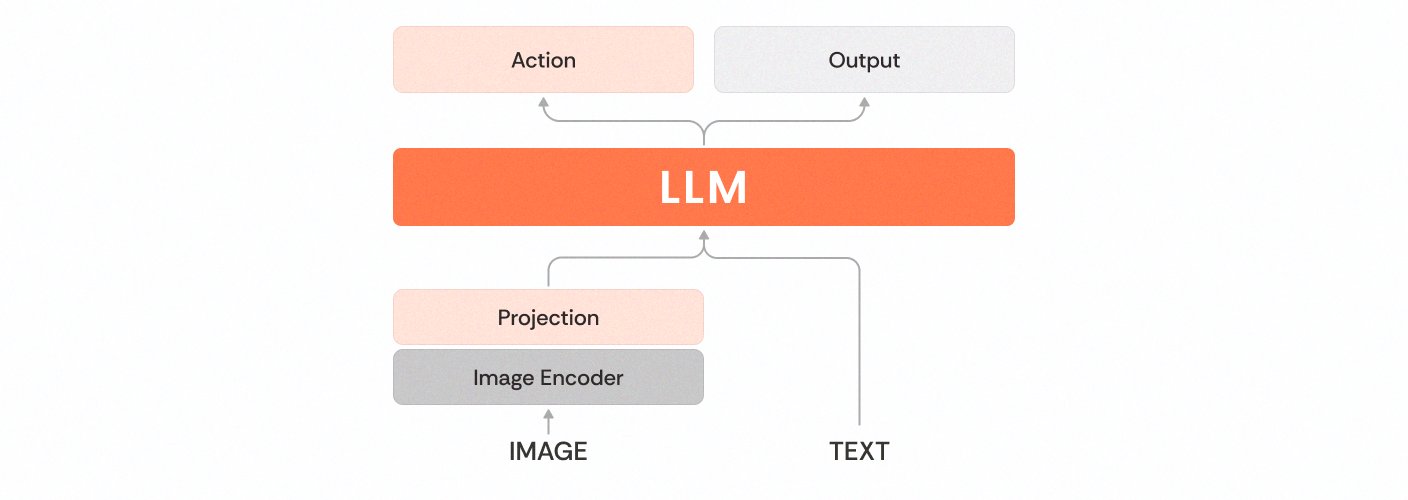
TL;DR: VLAs and LLMs share a transformer backbone and a similar training philosophy, but that's roughly where the similarity ends. LLM's mistakes stay on the page. A VLA's mistakes move through physical space.
Direct answer
A VLA (Vision-Language-Action model) and an LLM (large language model) both use transformer architectures trained at scale, but an LLM maps text to text while a VLA maps vision and language to physical motor commands. The difference isn't cosmetic; it changes what data each one needs, how each one fails, and how much a mistake actually costs.
The resemblance is real, and it's also where the comparison stops
VLAs are built on the same architectural lineage as LLMs. Transformer blocks, attention mechanisms, large-scale pretraining — the lineage is direct, and VLA researchers are open about borrowing it. That's not a coincidence; it's a deliberate bet that what worked for scaling language would also work for scaling physical control.
It's a reasonable bet. It's also an incomplete one.
Three modalities instead of one
An LLM operates in a closed world. Text goes in, text comes out, and every training example lives in the same medium the model outputs. A VLA has to fuse three distinct modalities: vision, language, action — into a single coherent output, and the training data has to capture all three linked together, not collected separately and stitched after the fact.
This is the part that trips people up who assume a VLA is "just an LLM with a camera bolted on." It isn't. Adding vision input to a language model gives you a model that can describe what it sees. Getting from description to correct physical action requires an entirely different category of training data — sequences that show what happened when a specific instruction met a specific scene.
What a wrong answer actually costs
A wrong token from an LLM produces an awkward sentence, maybe a factual error a person has to catch and correct. Annoying. Recoverable.
A wrong action from a VLA can knock something off a shelf. In a warehouse or a home, that's the low-stakes version. In a safety-critical setting, a wrong action isn't a bad sentence; it's a real event with real consequences that follow the robot, the task, and sometimes the person nearby.
That difference in consequence changes how much validation VLA training data actually needs before it's usable. An LLM dataset with a few bad examples produces a model that occasionally says something wrong. A VLA dataset with a few bad examples, a mislabeled action, a sequence where the instruction and the outcome don't actually match — can teach the model a physical habit that's expensive to unlearn later.
Why VLA training data can't just borrow what worked for LLMs
LLMs got their scale from the internet: an enormous, pre-existing archive of text that happened to be sitting there, ready to be tokenized. VLAs don't have an equivalent. There's no web-scale archive of "robot sees X, told to do Y, does Z, succeeds or fails."
That data has to be built, deliberately, one task at a time of real people performing real tasks in real environments, with everything they saw and did captured, validated, and linked together. For a broader look at how to build multimodal datasets for AI training, the same sourcing discipline applies across voice, image, and video data, not just robotics. It's a fundamentally different sourcing problem than scraping text, and it's the single biggest reason VLA progress has moved slower than LLM progress did at a comparable stage.
Where the two actually complement each other
None of this means VLAs and LLMs are unrelated. Most VLA training pipelines lean on language-model-style co-training — mixing internet-scale text and image data with physical robotics data — specifically to give the model semantic grounding before it ever has to predict a motor command. The LLM lineage isn't wasted; it's the reasoning layer the physical layer gets built on top of.
What this means for teams evaluating VLA vendors
If a vendor's data pitch sounds identical to how they'd pitch text data — volume, coverage, "diverse sources" — that's worth a second look. VLA data quality isn't just about volume; it's about whether the vision, language, and action components in each sequence are actually validated as a linked unit, since a VLA can learn a confidently wrong physical habit from data that would look perfectly fine as an LLM training example. This is exactly the kind of validation gap our data quality process is built to catch before it reaches a training pipeline.
How Humyn Labs supports the data side of VLA training
Humyn Labs isn't a data collection vendor. It's an independent multimodal human data company running the full pipeline VLA teams need — collection, validation, multilayer quality control, annotation, and human-in-the-loop review — delivered through verified domain experts, not ad hoc individual data collectors.
Clients don't get raw access to individual contributors, and that's not the priority anyway. What they get is a verified, first-party contributor network built from the ground up for the specific task at hand, so every vision-language-action sequence has already passed through validation before a client ever touches the dataset with the exact layer of scrutiny that a "wrong action has real consequences" field can't skip.
Instruction and environment diversity is where most existing VLA datasets fall short, so Humyn Labs sources contributors across the Global South and supports capture in low-resource languages from that region — closing a gap most datasets leave wide open.
The short version
VLAs inherited a lot from LLMs, but not the part that made LLMs scale easily. They inherited the hard part: three modalities to fuse, no existing internet-scale dataset to lean on, and consequences that don't stay contained to a screen.
Key Takeaways:
- VLAs and LLMs share a transformer backbone, but an LLM maps text to text while a VLA maps vision and language to physical motor commands
- A VLA requires training data that links vision, language, and action together as a validated unit — not three separate data types stitched after the fact
- LLM mistakes are recoverable; VLA mistakes are physical events with real-world consequences
- There is no internet-scale archive of vision-language-action sequences — this data must be deliberately captured from real-world tasks
- Most VLA pipelines use LLM-style co-training to build semantic grounding before physical action prediction
- VLA data quality depends on whether each sequence is validated as a linked unit, not just on volume or source diversity
FAQs
1. Is a VLA just an LLM with vision added?
No. Adding vision input to a language model produces a model that can describe scenes, not one that can act on them correctly. A VLA requires training data that links vision, language, and physical action together, which is a fundamentally different data problem.
2. Do VLAs and LLMs use the same architecture?
They share the same underlying transformer-based approach and training philosophy, but VLAs extend it to fuse three modalities: vision, language, action — instead of operating in a single medium like text.
3. Why can't VLA training reuse the internet-scale text data LLMs used?
There's no equivalent web-scale archive of paired vision-language-action sequences. That data has to be captured deliberately from real-world tasks, which is slower and more resource-intensive than scraping existing text.
4. What happens when a VLA makes a mistake, compared to an LLM?
An LLM's mistake is a bad sentence — recoverable and low-cost. A VLA's mistake is a physical action with real-world consequences, which raises the bar for how much validation VLA training data needs before it's usable.
5. Do VLAs use language models at all?
Yes, most VLA training pipelines use language-model-style co-training, mixing internet-scale text and image data with physical robotics data to give the model semantic grounding before it predicts physical actions.
6. What should teams look for when evaluating VLA training data vendors?
Whether the vision, language, and action components in each data sequence are validated as a linked unit, not just data volume or source diversity, which matter differently for VLA data than they do for text data.
7. How does Humyn Labs support VLA training data needs specifically?
Humyn Labs manages the full pipeline — collection through verified domain experts and a first-party contributor network, multilayer quality control, annotation, and human-in-the-loop review — to produce validated, training-ready vision-language-action datasets, including coverage across the Global South and low-resource languages.
More Articles
 ASR model comparison
Divyajot SinghSep 28, 20266 min read
ASR Models Have Different Failure Geometries
WER alone hides how ASR models fail. BRIDGE ASR 2.0 compares Gemini, GPT-4o, Saaras & Scribe on Indic, code-switched speech by error type.
Read Article→ body camera footage for ai
Pushpak AgrawalSep 10, 20264 min read
Body Camera Footage vs Scaled Crowdsourced Video: Sourcing Egocentric Data at Scale
Body camera footage caps first-person AI training data at whatever hardware a program can issue. See why scaled, verified crowdsourcing gets egocentric data further.
Read Article→ WER
WERDebashish GhoshSep 3, 20263 min read
A transcript that was perfect — yet scored 15% wrong
A perfect transcript can still fail a WER test when code-switched words have two valid spellings. Here's how a normalization pipeline removes the scoring artifact.
Read Article→