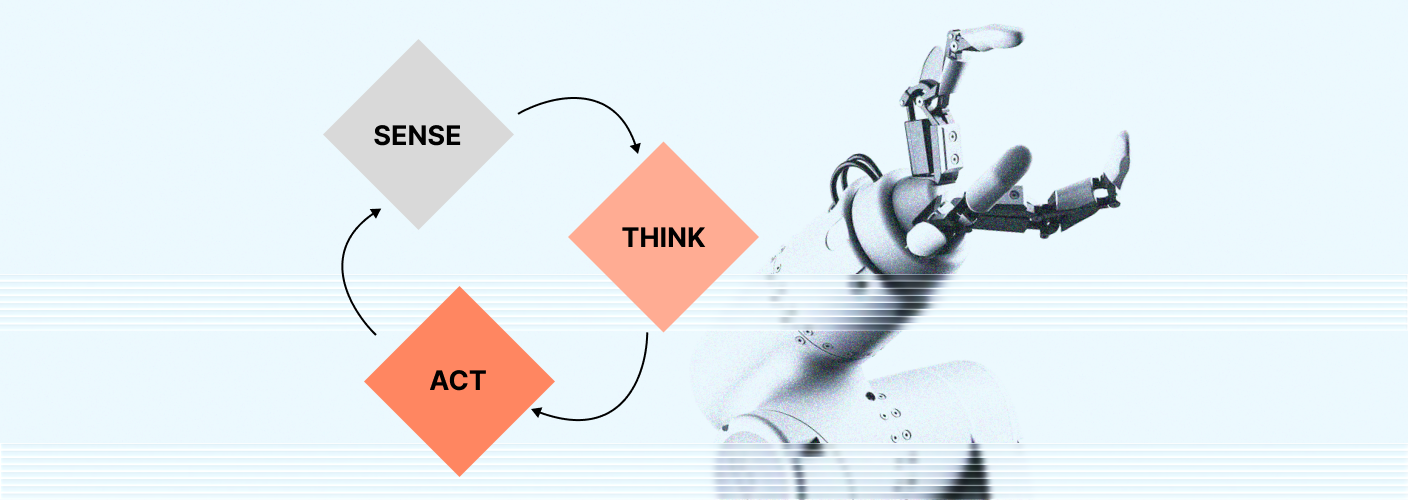
TL;DR: A Vision-Language-Action (VLA) model is a single AI system that sees a scene, understands an instruction, and outputs a physical action - no separate perception, planning, and control stack in between. The model's ceiling isn't set by architecture. It's set by how much real-world data it was trained on.
Direct answer
A Vision-Language-Action (VLA) model is an AI system that combines visual perception, language understanding, and physical control into one model. It takes an image or video and an instruction as input, and outputs a motor action directly - the same way a large language model takes text in and produces text out, except the output here moves an arm, not a cursor.
How VLAs actually work
Older robots run on a relay. A camera feeds a perception system. The perception system feeds a planner. The planner feeds a low-level controller that moves the joints or wheels. Each stage is built and trained on its own, and every handoff is a place for error to sneak in.
A VLA skips the relay.
It's trained end-to-end on paired examples - here's what the robot saw, here's the instruction, here's the action that followed - so it learns to go straight from pixels and words to motor commands. It's the same shift language models went through years ago: instead of hand-built grammar rules and separate reasoning modules, one model learns the mapping directly from data.
The three parts of a VLA: vision, language, action
- Vision — the model parses a scene: what's there, where it is, how it's arranged, how it changes as the robot moves.
- Language — the model interprets an instruction, whether it's blunt ("pick up the cup") or contextual ("hand me the other one").
- Action — the model outputs a stream of low-level motor commands a robot's controller can run directly, often dozens of times a second.
None of these three is the hard part on its own. Vision models are mature - built on the same foundation as vision-language models (VLMs). Language models are mature. The hard part is grounding the two of them in physical action - and that grounding only comes from training data that links all three together, not datasets that treat them as separate problems.
Why VLAs are different from traditional robotics models
Older robotics leaned on hand-engineered rules, simulation, and narrow task-specific training. That works fine on a factory line, where the range of objects and motions is fixed and predictable. It falls apart the moment the environment stops being fixed: a home, a warehouse where inventory turns over daily, a hospital corridor, a sidewalk.
VLAs are built for exactly that open-world mess. Trained on broad, varied examples of real tasks instead of a fixed rule set, they generalize to situations no one explicitly programmed for - a different mug, a cluttered counter, an instruction phrased slightly differently than anything in training.
VLA vs LLM: what's actually different
VLAs borrow the transformer architecture and training philosophy that made large language models work. The resemblance stops at the input and output.
An LLM's world is closed. Text in, text out, and every training example lives in the same medium. A VLA's world is physical: it has to fuse three different modalities at once, and its outputs have real consequences. A wrong token from an LLM produces a bad sentence. A wrong action from a VLA can knock something over - or, in a safety-critical setting, cause real harm.
That difference is why VLA training data can't simply borrow the internet-scale text corpora that powered LLMs. There's no equivalent web-scale archive of "robot sees X, told to do Y, does Z, succeeds or fails." That data has to be captured deliberately, from the real world, one task at a time.
Where VLA models are already being used
VLA research has moved fast from lab demo to applied pilot in a handful of areas:
1. Warehouse and logistics robotics, picking, sorting, and moving inventory that changes by the hour
2. Household and service robotics, where instructions are conversational and the environment is never staged
3. Manipulation research, teaching robots dexterous tasks like folding, pouring, assembling
4. Autonomous inspection and mobile robots, combining navigation with object-level understanding
Across all four, teams report the same bottleneck. It isn't model capacity. It's the availability of large, diverse, well-labeled real-world interaction data to train and evaluate against.
The real constraint on VLA progress: data, not architecture
Most of the recent gains in VLA performance have come from scaling and diversifying training data, not from new architectures.
A VLA that only ever sees one kitchen, one set of objects, one instruction style overfits to that narrow world - it looks competent in demos and falls apart the moment something's slightly off. A VLA that sees thousands of variations - different environments, different objects, different phrasings of the same instruction, and enough failed attempts alongside the successful ones - actually generalizes.
Take two robots trained to "pick up the bottle and place it in the bin." One is trained on 200 examples from a single lab, always the same bottle, same bin, same lighting. It works perfectly - in that lab. Put it in a different kitchen with a different bottle shape and dimmer lighting, and it fails more often than it succeeds. The other is trained on 200 examples spread across dozens of kitchens, bottle shapes, and lighting conditions. It's less polished in any one setting, but it keeps working when the setting changes. Same example count, very different outcome, because the second model actually learned the task instead of memorizing one instance of it.
This is also where most teams get stuck. Capturing this kind of data at scale means recruiting real people to perform real tasks in real environments, capturing what they see and do, and then validating and annotating that footage so it's actually usable for training. That's a data operations problem as much as a machine learning one.
What good VLA training data looks like
Strong VLA training data tends to share a few traits:
1. Diversity of environments and objects — not one lab, not one home, but a wide spread of physical settings
2. Paired vision-language-action sequences — the full chain (scene, instruction, action, outcome), not standalone images or standalone instructions
3. Coverage of edge cases and failures, not just the clean successful runs
4. Contributors from a genuinely varied population, so the data reflects how different people actually phrase instructions and perform tasks
5. Rigorous validation and quality control, since one mislabeled action or one poorly captured sequence teaches the model something wrong - and that error compounds across every task built on top of it
How Humyn Labs supports VLA training pipelines
Humyn Labs isn't a data collection vendor. It's an independent multimodal human data company running the full pipeline VLA teams need to go from raw real-world footage to training-ready data through our physical AI data services: collection, validation, multilayer quality control, annotation, and human-in-the-loop review, delivered through verified domain experts.
Clients don't get raw access to individual data collectors, and that's not the priority anyway. What they get is a verified, first-party contributor network built from the ground up for the specific task at hand - which means every environment, every instruction style, and every action sequence in the dataset has already been through validation before a client ever sees it.
Instruction diversity is where most existing robotics datasets fall short - they skew toward a narrow set of well-resourced regions, so a VLA trained on them learns one way of phrasing things. Humyn Labs sources contributors across the Global South and supports capture in low-resource languages from that region specifically, closing a gap most datasets leave wide open. Every contribution then passes through multilayer QC and human-in-the-loop annotation before it's considered training-ready. Teams aren't handed raw footage and left to sort it out - they're handed a validated, labeled dataset built for the vision-language-action pipeline from the start.
What's next for VLA models
The next phase of VLA progress looks less like bigger models and more like better data foundations: broader environment coverage, more languages and contributor backgrounds represented, tighter validation loops between what a model predicts and what actually happens in the physical world.
Teams that treat data quality as a first-class problem - not something to patch after a demo underperforms - are the ones closing the gap between lab results and robots that actually hold up in the real world.
Key Takeaways:
1. A VLA model combines visual perception, language understanding, and physical action into a single end-to-end system
2. VLAs generalize to new objects and instructions because they're trained on varied real-world data, not fixed rule sets
3. VLA training data must pair what the robot sees, the instruction given, and the action taken — this data doesn't exist at internet scale and must be deliberately captured
4. Data diversity across environments, objects, and instruction styles is the primary driver of VLA performance gains
5. Rigorous validation, annotation, and human-in-the-loop review are what separate training-ready datasets from raw footage
6. Instruction diversity and Global South language coverage are critical gaps in most existing robotics datasets
FAQs
1. What does VLA stand for?
VLA stands for Vision-Language-Action, describing a model that takes visual input and a language instruction and produces a physical action as output.
2. How is a VLA different from a regular robotics AI model?
Traditional robotics models run separate systems for perception, planning, and control. A VLA folds all three into a single model trained end-to-end, which is what lets it generalize to new objects and instructions instead of only handling pre-programmed cases.
3. Do VLAs need special training data?
Yes. VLAs need paired examples that link what a robot sees, the instruction it's given, and the action it takes. That kind of paired vision-language-action data has to be captured from real-world tasks - it isn't sitting in any existing internet-scale dataset.
4. Are VLAs the same as large language models applied to robots?
Not exactly. VLAs use a similar transformer-based architecture and training approach, but they operate across three modalities - vision, language, action - instead of one, and their outputs affect the physical world rather than just producing text.
5. What industries are adopting VLA models first?
Warehouse and logistics robotics, household and service robotics, dexterous manipulation research, and autonomous inspection are the areas where VLA models are being applied earliest.
6. Why is data diversity so important for VLA training?
A VLA trained on a narrow set of environments and instruction styles overfits to that narrow world - it works in the lab and struggles everywhere else. Diversity in environments, objects, and how people phrase instructions is what lets a model keep working when the setting changes.
7. How does Humyn Labs help teams building VLA models?
Humyn Labs runs the full data pipeline - collection through verified domain experts and a first-party contributor network, multilayer quality control, annotation, and human-in-the-loop review - to produce training-ready vision-language-action datasets, including coverage across the Global South and low-resource languages.
More Articles
 ASR model comparison
Divyajot SinghSep 28, 20266 min read
ASR Models Have Different Failure Geometries
WER alone hides how ASR models fail. BRIDGE ASR 2.0 compares Gemini, GPT-4o, Saaras & Scribe on Indic, code-switched speech by error type.
Read Article→ body camera footage for ai
Pushpak AgrawalSep 10, 20264 min read
Body Camera Footage vs Scaled Crowdsourced Video: Sourcing Egocentric Data at Scale
Body camera footage caps first-person AI training data at whatever hardware a program can issue. See why scaled, verified crowdsourcing gets egocentric data further.
Read Article→ WER
WERDebashish GhoshSep 3, 20263 min read
A transcript that was perfect — yet scored 15% wrong
A perfect transcript can still fail a WER test when code-switched words have two valid spellings. Here's how a normalization pipeline removes the scoring artifact.
Read Article→